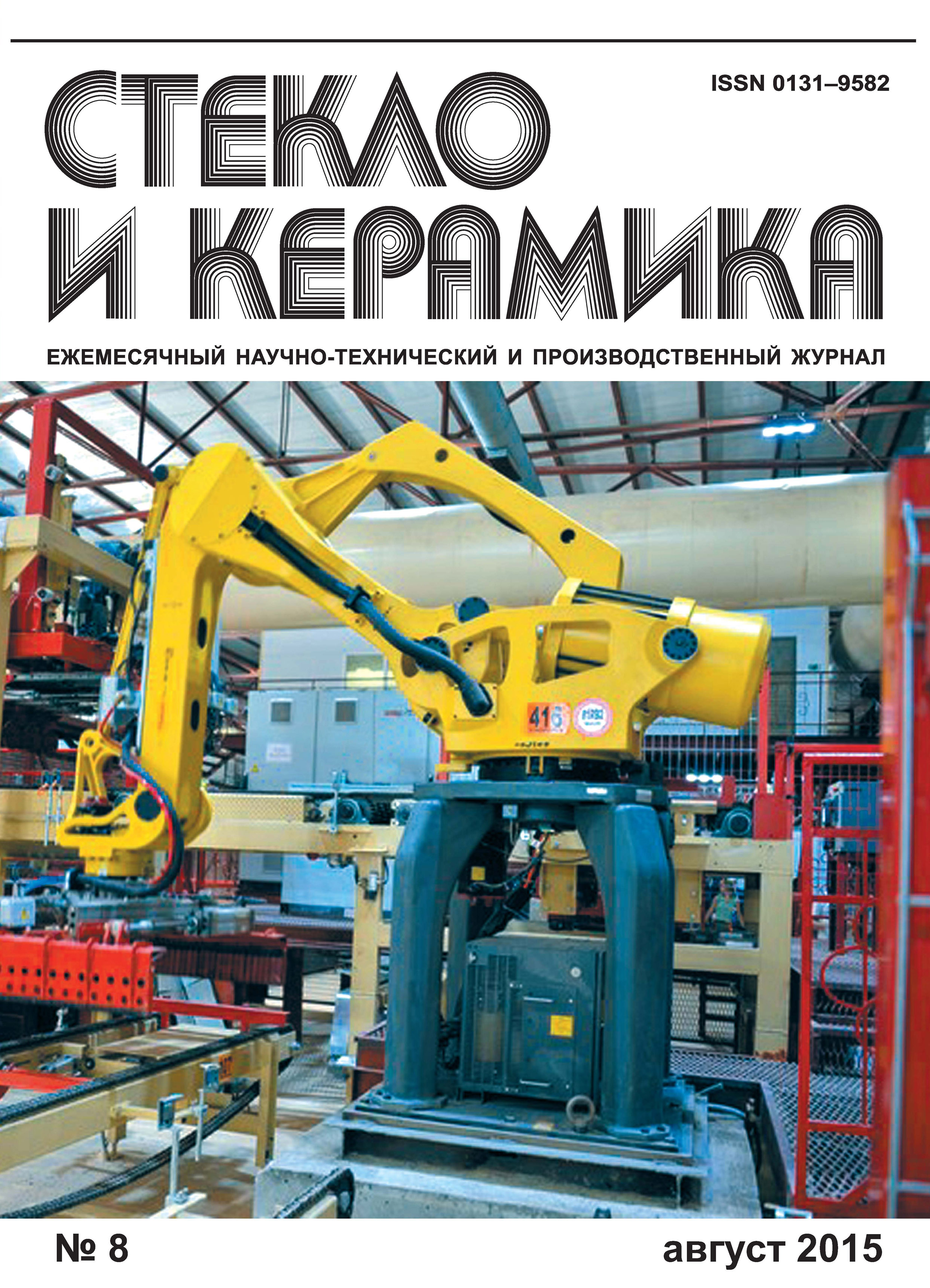
Steklo i Keramika (Glass and Ceramics). Monthly scientific, technical and industrial journal


ISSN 0131-9582 (Online)

VOL 88, No. 7 (2015)

Any article from the issue can be purchased in electronic form!

PDF format

Share:

    Science for ceramic production

  • A sol-gel method for making CeO2?ZrO2 based catalytic ceramic membranes

    • Pages: 11-12
    • Views: 19857
    Samples of catalytic ceramic membranes based on the CeO 2? ZrO 2 system by the sol-gel method have been synthesized. The morphology, phase composition and porous structure of membranes were investigated.
  • Phase and structure formation in ZnO and TIO2 based ceramics.

    • Pages: 16-19
    • Views: 19712
    Zn 2 TiO 4 - ZnO ceramic samples were obtained using zinc and titanium oxide nanopowders. Phase formation, as well as the microstructure and elemental composition of the phases being formed, have been studied by electron microscopy. The density and porosity were calculated, and the sizes of the grains and pores of the ceramics were estimated. The temperature at which zinc titanate is formed has been determined. It is shown that it corresponds to the sintering temperature of electrocontact materials of the given composition. Titanate and zinc oxide are supposed to be used as an arc extinguishing and dispersion-strengthening additive in copper-based electrical contact materials.
  • Ceramic filter media for aluminium melts (review)

    • Pages: 20-28
    • Views: 19734
    With the development of non-ferrous metallurgy, the requirements for the quality of the produced metals and products from them are increasing. During the production of aluminum, it is necessary to remove impurities present in the melt. A brief overview of the types of impurities in the aluminum melt and methods of their removal by means of melt filtration is given. Existing ceramic filters and methods of their manufacture are considered.
  • At the enterprises and institutes

  • Microwave treatment of silicates with alumina-based dopants

    • Pages: 39-43
    • Views: 19648
    The results of treatment with a microwave field of silicates (bentonite clay and quartz sand), the effect of the field on the structure and technological characteristics of aqueous suspensions of silicates, physical and mechanical characteristics of ceramic material obtained on their basis are considered. The role of additives (hydrosol of aluminum oxide and aluminum-containing galvanic sludge) on the technological characteristics of aqueous suspensions of silicates and the physical and mechanical properties of ceramic material based on them has been investigated.
  • Glassenamels firing with concentrated solar power

    Autors: Otmakhov V.I.
    • Pages: 44-46
    • Views: 19649
    The possibilities of using concentrated solar energy to create a light-emitting technology for producing art items with glass enamel are considered. Calculations have been carried out to select the optimal modes of the art enameling process on specially prepared wire frames
  • Biomaterials

  • Calcium phosphate based biomaterials development. Research infoware

    • Pages: 34-38
    • Views: 19628
    The description of the information system containing reference information on the physicochemical, biological properties of orthophosphates, pyrophosphates and ultraphosphates of calcium is given. In addition to reference information, the system contains an array of publications from various domestic and foreign search engines on the presented classes of calcium phosphates, as well as implantation materials based on them. The descriptions of the user and search interfaces of the system intended for specialists in the field of inorganic materials and medical materials science are given.

  • Coatings

  • Transparent glazes for high-voltage porcelain

    • Pages: 29-33
    • Views: 19665
    The results of the development of compositions of raw material compositions of transparent shiny glaze coatings used for the production of ceramic high-voltage porcelain insulators are presented. The area of ??the content of raw materials, providing the formation of defect-free coatings with the required set of dielectric characteristics, has been established.
  • Growth of the production efficiency

  • Computer-aided control of automobile glass quenching

    • Pages: 3-5
    • Views: 19841
    A mathematical model has been developed on fuzzy sets, which describes the dependence of the deviation of the shape of bent automobile glasses on the tempering mode. An adaptive algorithm for controlling the hardening mode using simplex planning is proposed. Simulation modeling shows the possibility of improving the quality of produced hardened glasses on existing equipment by automating the control of the hardening technological process.
  • The use of modified Petri networks as control models in glass batch making process

    • Pages: 6-10
    • Views: 19790
    It is proposed to use modified Petri nets, describing the operations that make up the technological process of preparing a glass batch, as control models of the technological process to ensure the efficiency of control over the preparation of glass batch in accordance with a given technical regulation due to the synchronization and consistency of the functioning of technological equipment