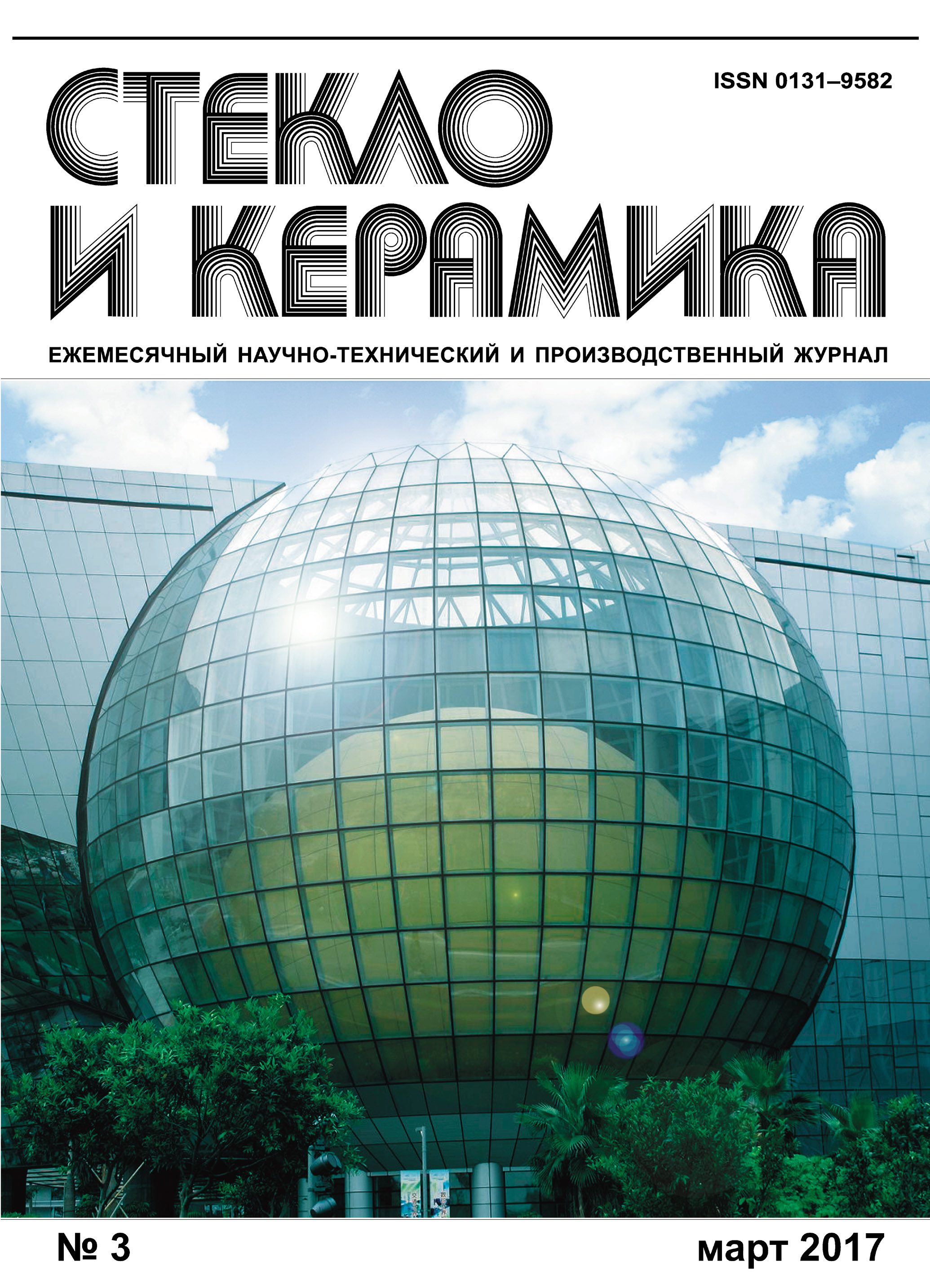
Steklo i Keramika (Glass and Ceramics). Monthly scientific, technical and industrial journal


ISSN 0131-9582 (Online)

VOL 90, No. 2 (2017)

Any article from the issue can be purchased in electronic form!

PDF format

Share:

    Science for glass production

  • Protection of BK10 optical glass polished surface from environ-mental impact

    • Pages: 3-5
    • Views: 15292
    Processes of changes in the state of polished surfaces of optical silicate glass BK10 are considered, the influence of the environment on them is determined. It was found that the treatment of polished surfaces of optical parts made of this glass in hexamethyldisilazane vapor leads to the creation of a protective hydrophobic film that prevents them from being exposed to high humidity.
  • Electric current influence on mass transfer process in S78-4 lead-silica glass

    • Pages: 6-8
    • Views: 15229
    The results of a study of the processes occurring during heating and isothermal holding at 450 ° C with passing an electric current through a sample of lead-silicate glass S78-4, widely used in electronic engineering, are presented. The dependences of the change in electrical conductivity on temperature and on the time of annealing were obtained for a continuous unidirectional current through the sample, as well as for an alternating current excluding electrical mass transfer. The results obtained can be used to improve existing and create new technological processes for the production of electronic products using lead-silicate glasses.
  • Science for ceramic production

  • Al2O3-ZrO2 (Y2O3)

    • Pages: 9-14
    • Views: 15245
    Nanosized additives (agglomerate size 30 ? 50 nm) of eutectic composition in the Al 2 O 3 -ZrO 2 (63 - 37%, mole fraction) containing 4% Y 2 O 3 (over 100%). In the process of electric pulse plasma sintering of the obtained powder compositions, the temperature of the appearance of the liquid phase Tr = 1720 ° C was established, which is 140 ° C lower than the temperature of the eutectic in the Al 2 O 3 - ZrO 2 (Te = 1860? С)
  • Features of structure formation in clinker ceramics

    • Pages: 15-19
    • Views: 15170
    The results of studying the microstructure of clinker ceramics of various chemical composition are presented, the data are systematized, and an explanation of the formation of the phase composition of ceramics in relation to the features of the production process and the properties of products is proposed. The data obtained make it possible to significantly facilitate the design of the composition of the charge, the prediction of the properties of products, the selection of the heat treatment mode, help to reduce rejects, as well as the selection of decorative coatings.

  • Utilization of waste

  • Cell heat-insulating construction glassmaterials made with steam power stations and iron industry waste

    • Pages: 20-22
    • Views: 15216
    The physicochemical processes of the formation of the cellular structure of heat-insulating building glass materials as a result of thermoplastic sintering of the charge at a temperature of 600? 870? C. The implementation of such a process for the formation of cellular glass is ensured by the fact that the formed significant volume of the gas phase at a reduced viscosity, diffusing in the thermoplastic glass mass, creates a porous structure of cellular heat-insulating glass
  • Influence of various coal preparation waste on mechanical behavior and phase composition of heat insulation materials

    • Pages: 23-28
    • Views: 15133
    Heat-insulating ceramic materials were obtained on the basis of coal preparation waste: flotation waste of coal preparation of GOF "Tomusinskaya", slimes of flotation coal preparation (coal slimes of the Central Processing Plant "Obukhovskaya"), waste of coal preparation of Abashevskaya Central Processing Plant and waste of coal preparation of "Korkinsky open-pit mine" using traditional materials It is shown that anorthite, cristobalite and hematite are formed at a firing temperature of heat-insulating materials of 1000 ° C. Heat-insulating brick of grades A and B received
  • Raw materials

  • Dzherdanak quartzite rocks for ceramic and refractory materials production

    • Pages: 33-36
    • Views: 15095
    The chemical and mineralogical compositions, physicochemical characteristics and the degree of degeneration of the quartz mineral in the highly siliceous rocks of the Dzherdanak deposit have been investigated. It has been established that this deposit, along with quartzites, also contains shales and sandstones. It is shown that these high-silica raw materials are promising for the development of compositions of ceramic and refractory materials.
  • Biomaterials

  • Composite bioceramics based on octacalcium phosphate decom-position products

    • Pages: 37-42
    • Views: 15049
    Composite bioceramics with a density of at least 80% of the theoretical was obtained from thermolyzed octacalcium phosphate (OCP). OCP processing temperatures were 450, 600, and 700 ° C. Ceramics were obtained by firing thermolyzed powders at a maximum temperature of 1000, 1050, and 1100 ° C with holding for 3, 6 and 9 h. The highest strength characteristics (up to 125 MPa when measuring the flexural strength) are demonstrated by samples obtained from OCP treated at 450
  • Coatings

  • Ceramic surface preparation for chemical silvering

    • Pages: 29-32
    • Views: 15103
    The influence of the method of surface preparation of ceramics from aluminum oxide on the structure and characteristics of the applied metal coating has been studied. Carrying out such stages of surface preparation as degreasing, etching, sensitization and activation, made it possible to obtain uniform metal coatings with high adhesion. In this case, the stages of sensitization and activation can be combined into one stage of direct activation