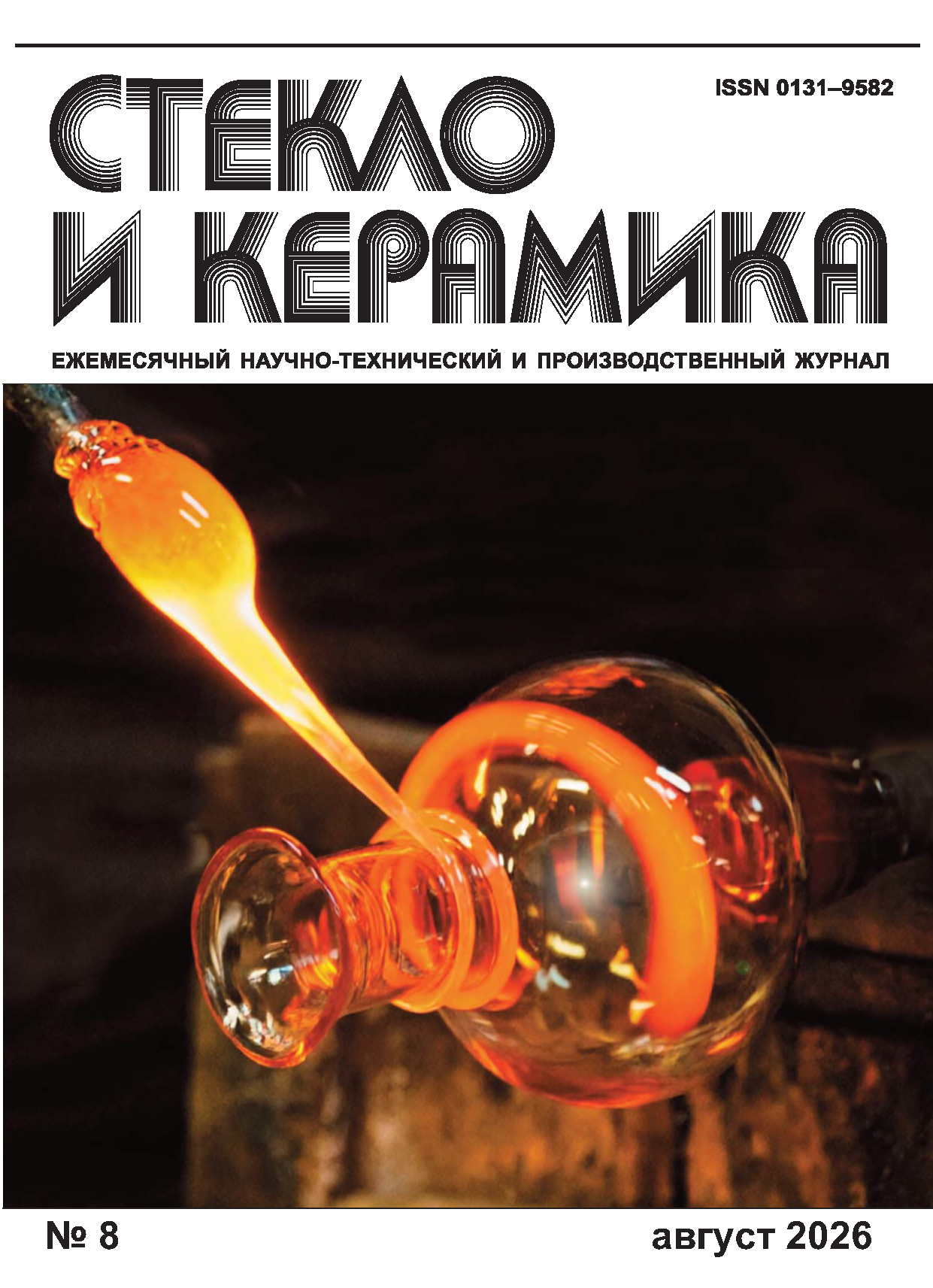
Steklo i Keramika (Glass and Ceramics). Monthly scientific, technical and industrial journal


ISSN 0131-9582 (Online)

VOL 99, No. 8 (2026)

Any article from the issue can be purchased in electronic form!

PDF format

Share:

    Not-set

  • INFLUENCE OF THE RARE-EARTH FLUORIDES ADDITIVE ON THE STRUCTURE AND PROPERTIES OF THE BOROPHOSPHATE GLASSES

    • Pages: 3-16
    • Views: 19
    In this work, we investigated borophosphate glasses with additions of 0.5 to 1.5 mol. % of rare-earth fluorides LnF3 (Ln = La, Ce, Nd), considered as simulants of radioactive waste from the now developing molten salt nuclear reactors. During the synthesis of the samples, it was found that even the small additions of LnF3 (?1.25 mol. % of LaF3 or NdF3, ?1.5 mol. % of CeF3) leads to formation of LnPO4 crystalline phase, which precipitated to the bottom of the crucible with the melt. This affects the ratios of the nominal and actual compositions of the glasses. Glass samples obtained from the upper, homogeneous, region of the melt exhibit an amorphous structure and a uniform distribution of the components throughout the volume. Their glass transition temperature Tg is 430 °C and remains constant over the entire range of the considered compositions; however, the introduction of LnF3 increases thermal stability and significantly changes the nature of crystallization processes. Moreover, for the samples with CeF3, the crystallization processes from that for the samples with LaF3 or NdF3, which is apparently due to the partial transition Ce3+ ? Ce4+. Analysis of the local structure indicates the presence of the ordering in the glass at the level of 2–3-coordination spheres and the invariance of phosphate groupings upon the introduction of LnF3. At the same time, with an increase in the LnF3 content, an increase in the proportion of 6-coordinated aluminum ions is detected, which is associated with the incorporation of fluoride ions into its environment. Consequently, in the environment of Ln ions, fluorine anions are replaced by oxygen, which causes the appearance of Ce4+. Based on the results of chemical and mechanical stability tests, it is shown that the glasses meet the regulatory requirements for the matrices for immobilization of radioactive wastes and can be considered as promising matrices for the incorporation of rare-earth fluorides.

  • THE EFFECT OF ZIRCONIUM DIOXIDE NANOPARTICLES ON THE PROPERTIES OF CORUNDUM CERAMICS BASED ON RUSSIAN RAW MATERIALS

    • Pages: 17-21
    • Views: 13
    The effect of various concentrations of zirconium dioxide nanoparticles on the strength and porosity of corundum ceramics obtained from domestic raw materials has been studied. The effect of an additive of eutectic composition on these properties is considered. It was found that the introduction of 20 wt. % solid solution based on zirconium dioxide and 5 wt. %. The addition of a eutectic additive in the MnO–TiO2 system to the aluminum oxide matrix makes it possible to obtain ceramics with a bending strength of up to 600 MPa.
  • ELECTRON-BEAM POWDER SURFACING OF Al2O3 ONTO TITANIUM IN THE FORE-VACUUM PRESSURE RANGE WITH PRELIMINARY POWDER DEGASSING

    • Pages: 22-29
    • Views: 12
    The results of producing an Al2O3 composite coating on titanium by electron-beam cladding in the forevacuum pressure range (3…30 Pa) are presented. The microstructure, phase composition, and mechanical properties of the resulting composite layer were investigated. Using scanning electron microscopy, energy-dispersive X-ray spectroscopy, and X-ray diffraction analysis, it was found that the coating consists predominantly of the ?-phase of Al2O3 (82 %), along with ?-Ti and cubic TiO. The average surface microhardness reaches 13.6 GPa, which is five times higher than that of the uncoated titanium. It was shown that preliminary outgassing of the powder by electron-beam irradiation ensures process stability and the formation of a dense composite layer. The obtained results demonstrate the promise of the developed method for creating ceramic coatings on titanium.
  • EVALUATION OF THE PROPERTIES OF FUNCTIONAL-GRADIENT CERAMIC MATERIALS OBTAINED BY THE METHOD OF CO-REACTION SINTERING

    • Pages: 30-40
    • Views: 12
    Monolithic samples of functionally graded ceramic materials were fabricated via reaction sintering (siliconizing) of silicon carbide and diamond powders. The resulting materials are layered composites bonded by a continuous silicon carbide matrix through a reaction-diffusion mechanism. Structural characterization and physicomechanical testing of the multilayer ceramics were performed on prototype samples. The microstructural features of reaction-bonded materials based on silicon carbide and diamond–silicon carbide composites, both as monoliths and within multilayer architectures, are experimentally described. Recommendations are provided regarding the potential applications of functionally graded silicon-carbide-based ceramics with diamond particles in specialized engineering fields.
  • PREPARATION OF FINE MAGNESIUM ALUMINATE SPINEL POWDER BY SHS: EFFECT OF NaCl MINERALIZER ON PHASE COMPOSITION AND DISPERSITY

    • Pages: 41-48
    • Views: 10
    Magnesium aluminate spinel in a submicron state was obtained for the first time directly in a combustion wave by self-propagating high-temperature synthesis (SHS) from aluminum and magnesium oxides, using aluminum powder as an energetic component and magnesium nitrate as an oxidizer, with the addition of 1 wt. % NaCl as a mineralizer. It was established that the introduction of 1 wt. % NaCl into the reaction mixture significantly increases the degree of conversion of the reaction products, promotes the formation of the target cubic spinel phase, reduces the content of secondary oxides (MgO, Al2O3), and eliminates the ?-Al2O3 phase within the detection limits of X-ray diffraction (XRD). The formation of an ordered spinel structure and the presence of eutectic-composition whisker crystals growing via a vapor–liquid–crystal mechanism were confirmed by XRD, FT-IR spectroscopy, and scanning electron microscopy combined with energy-dispersive spectroscopy (SEM-EDS). The synthesized powder exhibits a multimodal particle size distribution with a dominant fraction in the range of 0.8…1.4 µm, as revealed by laser diffraction analysis.
  • TEMPERATURE AND TIME PARAMETERS FOR THE SYNTHESIS OF AMORPHIZED INORGANIC COATINGS FOR PROTECTING THE INNER SURFACE OF STEEL PIPELINES

    • Pages: 49-56
    • Views: 11
    The article is devoted to the study of optimal temperature-time conditions for the formation of amorphized inorganic coatings for the internal protection of main pipelines. A glass-enamel frit composition based on the aluminoborosilicate system RO–R2O–B2O3–Al2O3–SiO2–TiO2 has been developed. The influence of the temperature and time of batch boiling (in the range of 800…1400 °C) and subsequent coating firing (in the range of 700…950 °C, holding for 0.5…3.5 min) on the structure and quality of the protective layer has been studied using X-ray phase analysis and optical microscopy. It has been established that complete transition to the amorphous state and homogenization of the melt are achieved at a boiling temperature of 1300 °C for 30 min. A continuous, pore-free coating with high adhesion to steel is formed at a firing temperature of 925 °C and a holding time of 3.0 min. The developed conditions improve the operational reliability of pipelines, reduce energy costs, and reduce the duration of the process cycle.
  • POWDER AND VOID. EXPERIENCE IN USING TWO-PRODUCT TRIBOKINETIKA MILLS IN THE PRODUCTION OF GROUND CHAMOTTE POWDER WITH IMPROVED PARTICLE SIZE DISTRIBUTION

    Autors: Lipilin A. B.
    • Pages: 57-60
    • Views: 18
    The article presents experience in producing milled chamotte powders with improved particle size distribution using a two-product impact-centrifugal mill. It is shown that dense particle packing is achieved by polydisperse two-fraction mixtures with a size ratio of about 10 between fractions. The technological scheme includes an open-circuit grinding with air classification followed by screening on a vibrating screen. Two fractions are obtained: fine powder (?0.06 mm) and granular fraction (0.3…2.0 mm) in a ratio of 1:2 after recycling of oversize and undersize products. The final two-fraction powder (33.3 % fine fraction, 66.7 % granular fraction) exhibits porosity below 15 % (compaction coefficient 0.85). Energy consumption is 22.8 kWh per tonne of finished product. The economic feasibility of using two-product mills for producing chamotte powders for ceramic and refractory applications is substantiated.